Westminster Diocesan Archives will be closed on Tuesday 16 July 2013 owing to a power cut caused by building works. This means that it will not be possible to use the reading room or contact us by phone. Emails should still work.
We hope that normal service will resume on Wednesday 17th.
Monday, 15 July 2013
Tuesday, 7 May 2013
'The World is Our House' Hereford Cathedral 21 June 2013
This conference is advertised on behalf of Hannah Thomas of Swansea University:
Information about the programme and booking is available on the conference blog here: http://worldisourhouse.blogspot.co.uk/
A Midsummer
symposium on international Jesuit culture, 1540–1700, with an evening concert of
early Jesuit music, to celebrate the re-evaluation of the Cwm Jesuit Library,
housed at Hereford Cathedral since 1679. The library, the largest
surviving seventeenth-century Jesuit missionary library in Britain, is
currently being analysed in depth as part of an exciting joint project between
Swansea University and Hereford Cathedral, funded by the UK Arts and Humanities
Research Council (AHRC). The study day will place the library within its larger
international context by exploring the rich and fascinating world of
seventeenth-century Jesuit culture.
The symposium and concert
have been made possible thanks to generous sponsorship from the Jesuit
Institute in London, the British Province of the Society of Jesus, and a donor
who wishes to remain anonymous.
Information about the programme and booking is available on the conference blog here: http://worldisourhouse.blogspot.co.uk/
Tuesday, 2 April 2013
Payments and Donations Online
One unexpected Easter blessing has been the setting up of an online donations page for Westminster Diocesan Archives. Many thanks to the diocesan IT department and web developers who have helped set this up.
Unlike many archives in the UK, we receive no public money or external funding. Our running costs are supported entirely by the diocese and any donations that wellwishers are generous enough to make. We run on a tiny budget and any donations are a great help to ensure that we can stay open and free to researchers.
WDA Donations Page
We do charge for some services -photography (self service and orders) and paid research for those who are unable to visit in person. We are going to trial using the new donation system as a way of paying for these online. It will still be possible to pay by cash or cheque but this should make things much easier for our users from abroad.
Over the next few weeks, we'll be taking a look at our policies and charges for paid research and photography to make sure that they'll still work with the new system and that the charges are fair. Once this is done, they'll be up on the website.
Unlike many archives in the UK, we receive no public money or external funding. Our running costs are supported entirely by the diocese and any donations that wellwishers are generous enough to make. We run on a tiny budget and any donations are a great help to ensure that we can stay open and free to researchers.
WDA Donations Page
We do charge for some services -photography (self service and orders) and paid research for those who are unable to visit in person. We are going to trial using the new donation system as a way of paying for these online. It will still be possible to pay by cash or cheque but this should make things much easier for our users from abroad.
Over the next few weeks, we'll be taking a look at our policies and charges for paid research and photography to make sure that they'll still work with the new system and that the charges are fair. Once this is done, they'll be up on the website.
Wednesday, 6 March 2013
Cardinal Vaughan and Westminster Cathedral

This newly discovered letter from Vaughan to his secretary, Mgr Dunn reveals his personal care for every detail of building the new Westminster Cathedral, and the occasional perils of being a Cardinal's secretary.
September 17 1902
“In my room, in a
corner near the stand up desk, is a basket full of stones from old
Cathedrals and Abbey Churches.....there are missing from the
Cathedrals -Canterbury, Hereford and Westminster Abbey Church -and
perhaps some others...write to the priests in Hereford and Canterbury
in my name, say we have all the old Cathedrals except so and so.
Hereford will be very easy to get, because in the cloister there is a
great heap of stones taken out of the old building. As we only want a
few inches of the old material -it ought not to be difficult to pick
up something in Westminster Abbey also.
Next, take a hammer and
divide each stone into 3 pieces -one to go into the cement or
grouting of the High Altar, one for the Blessed Sacrament Altar, and
a third from the Lady Altar. There are some larger stones, finials
etc -which might be kept for the Lady Altar as entire as possible and
so arranged in building up the side of the altar as to be visible to
any one looking at it for that purpose.”
So far we have not been able to discover whether Vaughan managed to collect all the Cathedrals, whether the stones were in fact cemented into the new cathedral altars and if poor Mgr Dunn was sent to Westminster Abbey under cover of darkness with a hammer and chisel. Any further information would be appreciated!
Wednesday, 20 February 2013
Augustinian Canonesses at Ealing
In 1911, the English Augustinian convent at Neuilly, on the outskirts of Paris was forced to leave France as Catholic educational establishments were closed by laws separating church and state. The canonesses settled in Ealing and built themselves a new home which survives today as St Augustine's Priory School.
A brief history can be found on the school website but, for anyone interested, the entire community archive from its foundation in 1634 to closure in the 1990s is held here in the archive.
The community journals describe some incidents of everyday life in Ealing:
"Great excitement during recreation. A box tied with string and thrown over the fence along Hill Crest Rd. was found to contain a large hedge-hog, and this in turn, led to the discovery of a "nest", complete with father, mother and no less than five "baby" hedge-hogs -dear little creatures -(to some!)"
 |
| By Calle Eklund/V-wolf (Own work) [CC-BY-SA-3.0 (http://creativecommons.org/licenses/by-sa/3.0) or GFDL (http://www.gnu.org/copyleft/fdl.html)], via Wikimedia Commons |
Monday, 23 July 2012
As we sort and appraise papers in the archive for cataloguing, occasionally information comes to light that saves us a considerable amount of work. Here is an item level list of volume E11 which we think was prepared by Elizabeth Poyser who was diocesan archivist from 1969 to 1980. This is a bound volume of letters which appear to have belonged to Henry Stuart, Cardinal Duke of York. Here is a part of her description of the whole collection:
"The whole set appear to have belonged to the Cardinal York, and
fall into two lots, pp.1-148 and 149-506.
The latter are letters from Lady H Webb at Paris to the Cardinal,
from 12 Nov. 1764 to 27 Oct. 1766, mostly written once a
week. At the beginning are some letters to her, sent on to
Rome, including some which appear to be from the Young Pretender
or some servant. Clearly many enclosures do not now
survive. Till 1766 they deal with efforts to reconcile the
Pretender to his father and brother, also news of French
Court, etc. From July 1766 (thereis a gap between Jan. and
July 1766) there are copies of the Cardinal's replies alternating
with Lady Webb's letters, detailing efforts to reform
the Pretender's drinking habits, etc. At p. 503 there is
reference to a Webb letter of 20 Oct. which is missing and
probably corresponds to the four missing pages; clearly an
important letter referring to an impertinent query, possibly
on matrimonial affairs.
The former are a mixed set, the bulk falling between autumn 1765
and summer 1766, but five documents date from 1763, 1767 (2),
1769 and 1771. There are some letters of the Young Pretender
to Cardinal York on their reconciliation, and others
dealing with the Cardinal's efforts to obtain recognition
for his brother from the Vatican."
We can't make any guarantees as to the complete accuracy of the list and we hope that it will eventually be improved and become part of our online catalogue.
"The whole set appear to have belonged to the Cardinal York, and
fall into two lots, pp.1-148 and 149-506.
The latter are letters from Lady H Webb at Paris to the Cardinal,
from 12 Nov. 1764 to 27 Oct. 1766, mostly written once a
week. At the beginning are some letters to her, sent on to
Rome, including some which appear to be from the Young Pretender
or some servant. Clearly many enclosures do not now
survive. Till 1766 they deal with efforts to reconcile the
Pretender to his father and brother, also news of French
Court, etc. From July 1766 (thereis a gap between Jan. and
July 1766) there are copies of the Cardinal's replies alternating
with Lady Webb's letters, detailing efforts to reform
the Pretender's drinking habits, etc. At p. 503 there is
reference to a Webb letter of 20 Oct. which is missing and
probably corresponds to the four missing pages; clearly an
important letter referring to an impertinent query, possibly
on matrimonial affairs.
The former are a mixed set, the bulk falling between autumn 1765
and summer 1766, but five documents date from 1763, 1767 (2),
1769 and 1771. There are some letters of the Young Pretender
to Cardinal York on their reconciliation, and others
dealing with the Cardinal's efforts to obtain recognition
for his brother from the Vatican."
We can't make any guarantees as to the complete accuracy of the list and we hope that it will eventually be improved and become part of our online catalogue.
Tuesday, 15 November 2011
Cleaning Cardinal Hinsley
One of the tasks involved in preserving our archive collections is ensuring that they are kept as clean as possible. We do this by regular cleaning of our storeroom and shelves and protecting material from the external environment as far as possible by boxing, wrapping in acid free tissue or using melinex sleeves. When necessary, we also clean individual items -a task which is often done by our volunteers.

They don't always get something as exciting as Cardinal Hinsley's death mask but dusting with a soft brush has significantly improved his appearance. We also discovered that the process of creating this must have removed large amounts of the late Cardinal's hair. Our mask has eyelashes, eyebrows and a tiny beard!

They don't always get something as exciting as Cardinal Hinsley's death mask but dusting with a soft brush has significantly improved his appearance. We also discovered that the process of creating this must have removed large amounts of the late Cardinal's hair. Our mask has eyelashes, eyebrows and a tiny beard!
Wednesday, 20 July 2011
Revised Opening Hours: September 2011
From 5th September 2011, opening hours at Westminster Diocesan Archives will change. The archive will now open on Tuesdays and Wednesdays and will be closed to the public on Mondays.
There will be two research sessions per day, from 10am until 12:30pm and from 2pm until 5pm. Between 12:30 and 2, the archive will be closed for lunch and all researchers will need to leave the premises.
Booking in advance will still be necessary but there will now be a choice of morning, afternoon, or both sessions. We hope that this will increase the availability of appointments in busy periods and the number of hours per week that we are open to the public, as well as ensuring that the archive remains fully staffed during opening hours.
There will be two research sessions per day, from 10am until 12:30pm and from 2pm until 5pm. Between 12:30 and 2, the archive will be closed for lunch and all researchers will need to leave the premises.
Booking in advance will still be necessary but there will now be a choice of morning, afternoon, or both sessions. We hope that this will increase the availability of appointments in busy periods and the number of hours per week that we are open to the public, as well as ensuring that the archive remains fully staffed during opening hours.
Tuesday, 14 June 2011
Summer Closure 2011
Westminster Diocesan Archives will be closed to researchers during August. The last slot available for booking will be the afternoon of Wednesday 27 July and we will reopen on Monday 5th September.
The archivists don't get to spend a month at the beach as we will still be working on tasks which are difficult to do when people are here such as cleaning, preservation work, maintenance and stocktaking. Our enquiry service will still be operating but replies may take a little longer than usual.
The archivists don't get to spend a month at the beach as we will still be working on tasks which are difficult to do when people are here such as cleaning, preservation work, maintenance and stocktaking. Our enquiry service will still be operating but replies may take a little longer than usual.
Monday, 11 April 2011
The Cardinal

When we finished cataloguing the Manning papers, we though it would be a good idea to celebrate in The Cardinal, a pub behind Westminster Cathedral named after Cardinal Manning. But we couldn't, because The Cardinal is closed for refurbishment and when it re-opens, it may not even be The Cardinal any more but the Windsor Castle. Archbishop Vincent is backing the campaign to save this historic name and has said that changing it "risked losing a reminder of the Catholic Church's long-standing commitment to the social good".
Throughout his career, Manning was concerned with social charity and improving the conditions of working people. An overview and assessment of his efforts in this area can be found in McClelland's work Cardinal Manning, His Public Life and Influence, especially in Chapter 5 'The Condition of the People'.
However some of the recently catalogued material at Westminster also provides insights into this area of his ministry. A letter from Manning to Herbert Vaughan (Ma. 2/25/40) describes an attempt on his part to prevent though arbitration a repeat of the 1889 dock strike in February 1890 and the hostility of the Times newspaper to his efforts. He writes:
"Last Wednesday, we were again on the brink of a second strike. Mr Buxton and I called together Burns, Warren a Mc Carthy and others [union leaders]. They met in this house on Wednesday night. After two hours we got them to withdraw the Manifesto which would have caused the Strike...The Times knows all this but on Monday attacked and sneered at the men and ignored us. On that day the strike would have begun, but for that Wednesday night".
During the 1889 strike, the press had sided with the workers, with the exception of the Times. Manning had often written letters to the Times urging the Government to provide relief work during the financial crisis. As McClelland notes, he had written in even stronger terms in other publications including that a man's right to life and food prevailed over all laws of property and these were views that "were anathema to The Times and they branded the Archbishop as a dangerous man in the eyes of many Roman Catholics".
Manning ends his letter with an instruction to Vaughan to carry on in this work:
"Go boldly and mix with the English people. They will trust you but not my brother Benson".
His 'brother Benson' may be Edward White Benson, Archbishop of Canterbury who had supported Manning's actions.
A petition to save The Cardinal can be found here. The Diocesan Archivist requests that anyone signing it also mentions another tradition which ought to be continued -the wide range of real ales.
Photo source: Diocese of Westminster, http://www.rcdow.org.uk/diocese/default.asp?library_ref=4&content_ref=3310
Tuesday, 22 March 2011
Shaping the Religious Archives Landscape
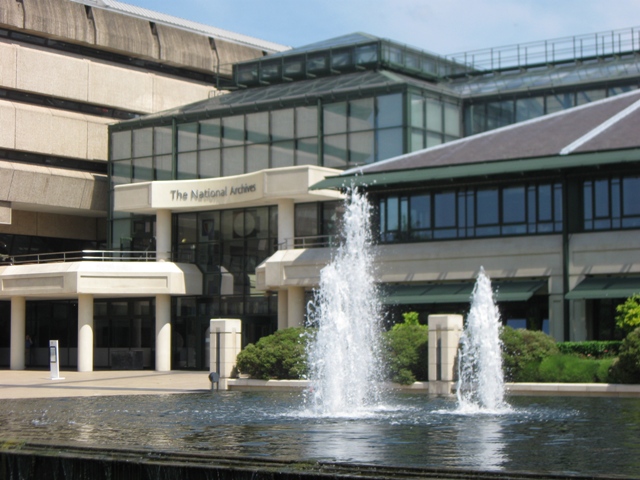
Image by Chris Reynolds, source here

The National Archives, in in conjunction with the Religious Archives Group is holding a consultative meeting at The National Archives in Kew on the afternoon of Monday, 4 April (from 1215 to 1700) to discuss the findings and recommendations of the Religious Archives Survey 2010. There will be contributions from key partner organisations including the Religious Archives Group, Archives and Records Association, British Library, British Records Association and Ecclesiastical History Society.
The survey report is available at http://www.nationalarchives.gov.uk/religiousarchives/
I will be chairing a workshop on how religious archives can use new media including website archiving, video and oral history and social media. Maybe somebody told them I had a blog! Fr Stewart Foster, Brentwood diocesan archivist, will be speaking on the importance of religious archives to their creators.
Monday, 28 February 2011
Fame at last!

Recently, we have been preparing for an important visit to the archive. As the collections belong to the Archbishop of Westminster, we decided to invite him to visit for a look at his own treasures.

In this picture, Archbishop Vincent is looking at H38, Memoriale presbyterorum parochialium, a handbook for parish priests assembled by an early 15th century Carthusian of theological texts and extracts. Here, we are trying to make out a recipe for ink. This volume contains the oldest item in the archive as 14th century fragments were used as part of the binding.
More images from the visit can been seen at the diocese's flickr photostream
Monday, 31 January 2011
Volunteering at Westminster

Joe has been carrying out simple preservation work on sacramental registers and checking that they are all shelved in the right order! He has also done some transcriptions and appraisal. In the picture above, he is listing a collection of photographs from the 1982 Papal Visit.
As we are a small archive which only opens three days a week, places for volunteers are limited. However, we are always happy to receive CVs, especially if you are thinking of a career as an archivist, so we can get in touch if a vacancy arises.
Wednesday, 19 January 2011
Great and Manifold Blessings

The world of religious archives is, at the moment, getting excited about Cambridge University Library's exhibition marking 400 years since the publication of the authorised version of the Bible. More information, including captions from the exhibits, is available here .
The exhibition also contains two early printed editions of Catholic translations by Gregory Martin, The Holie Bible and The New Testament of Jesus Christ, one published at Douai in 1609 and the other at Rheims in 1582. Together, in a revised version by Bishop Richard Challoner, these remained as the standard Catholic translation, the Douai Rheims Bible, until the 20th Century.
You may also enjoy the 'Wicked Bible' and the 'Unrighteous Bible' so called because of the accidental ommission of some key words. If only we could still fine people half a million and throw them into prison for bad proof reading...
Tuesday, 11 January 2011
2010 in Figures

Archivists can do just about anything. Certainly, working here requires a wide range of skills from bleeding radiators, changing lightbulbs and oiling swords to deciphering the handwriting of successive Cardinals and being able to work out where the really exciting letter which is neither addressed, dated or signed might possibly come from.
However, the one thing they don't teach archivists is maths. Nevertheless, here are our visitor statistics for 2010 which may or may not be accurate:
Over the year, we had 152 visits by 79 users, 10 of whom visited more than once. Of these, 68 were new visits (that is, a completely new user, or a user visiting for a new research subject) and 84 repeat visits. This is slightly down on last year's figures but we were closed in January for stocktaking and August-September for the training of new staff.
Our collection most in demand is the Parish Registers, which has been used by 29 visitors, mainly for family history which continues to be a popular reason for visits. Nearly half of our researchers do not have an academic or business affiliation. The A Series, including letters of the Vicars Apostolic of the London District, is our most popular collection for academic researchers. One collection which remains popular every year, although not strictly archival, is our complete set of Catholic Directories. These are getting harder and harder to find in major libraries but remain on open access shelves in our reading room.
I could provide the full figures with tables and pie charts but I think those can wait for the next advisory council meeting!
Tuesday, 21 December 2010
Cardinal Manning and France
 |
| Now safely packed in acid-free boxes |
Among the Manning papers are some letters to the Cardinal from a Mr J C Millage, a journalist based in Paris. Mr Millage appears to have decided to be an agent for Manning in France although there is little evidence that he was asked to do so. His letters are an eccentric mix of gossip, politics and personal requests.
In a letter of 4th February 1882 (Ma.2/16/2) he writes to Manning ostensibly to ask for a letter of introduction to Prince Henri, Duc d’Aumale, the Inspector-General of the French Army and a son of the exiled King Louis-Philippe. In the next paragraph however he informs that Cardinal that he can “obtain the concurrence of three generals willing to make a “coup d’etat” and place Monseigneur in the Elysée” this he sees as the “only way of preventing a socialistic revolution in France”.
To whom this refers is unknown but it is presumably one of the sons of Louis Philippe possibly Prince Henri or Prince François, who had put his name forward for the Presidency in 1851.
The next year Millage writes again on French politics (Ma.2/16/6 dated 11th February 1883). In this letter, he discusses the possibility of Prince Peter Kropotkine (sic) being pardoned and worries that Louise Michel and her supporters may cause trouble. He then returns to his theme of the previous year, telling Manning that Jules Grévy is ill and may soon resign, and that army morale can only be supported by a Presidency of “the person I mentioned as a forerunner to Constitutional Monarchy”. In fact Jules Grévy remains President until 1887.
There is absolutely no evidence in the Manning Papers that the Cardinal ever considered supporting an attempt to re-establish the monarchy in France, although in a letter to Herbert Vaughan of 1880 (Ma.2/12/20) he does bemoan the weakness of the French government and fear the resurgence of the Communards.
We hope that the new Manning catalogue will be available on Catholic Heritage early next year and would like to thank Tobias for all his work and wish him well for the future.
Monday, 13 December 2010
Welcome
Welcome to the archives blog for the Archdiocese of Westminster. This is intended to provide the information you will need to plan a visit to the archive, details on our collections, updates on our work and any snippets of Catholic history that take the fancy of the archivists.
To find out more about the collections held at the archive, go to 'our collections', to plan a visit to the archive, go to 'visiting us' and to get in touch, have a look at 'contact us'.
To find out more about the collections held at the archive, go to 'our collections', to plan a visit to the archive, go to 'visiting us' and to get in touch, have a look at 'contact us'.

